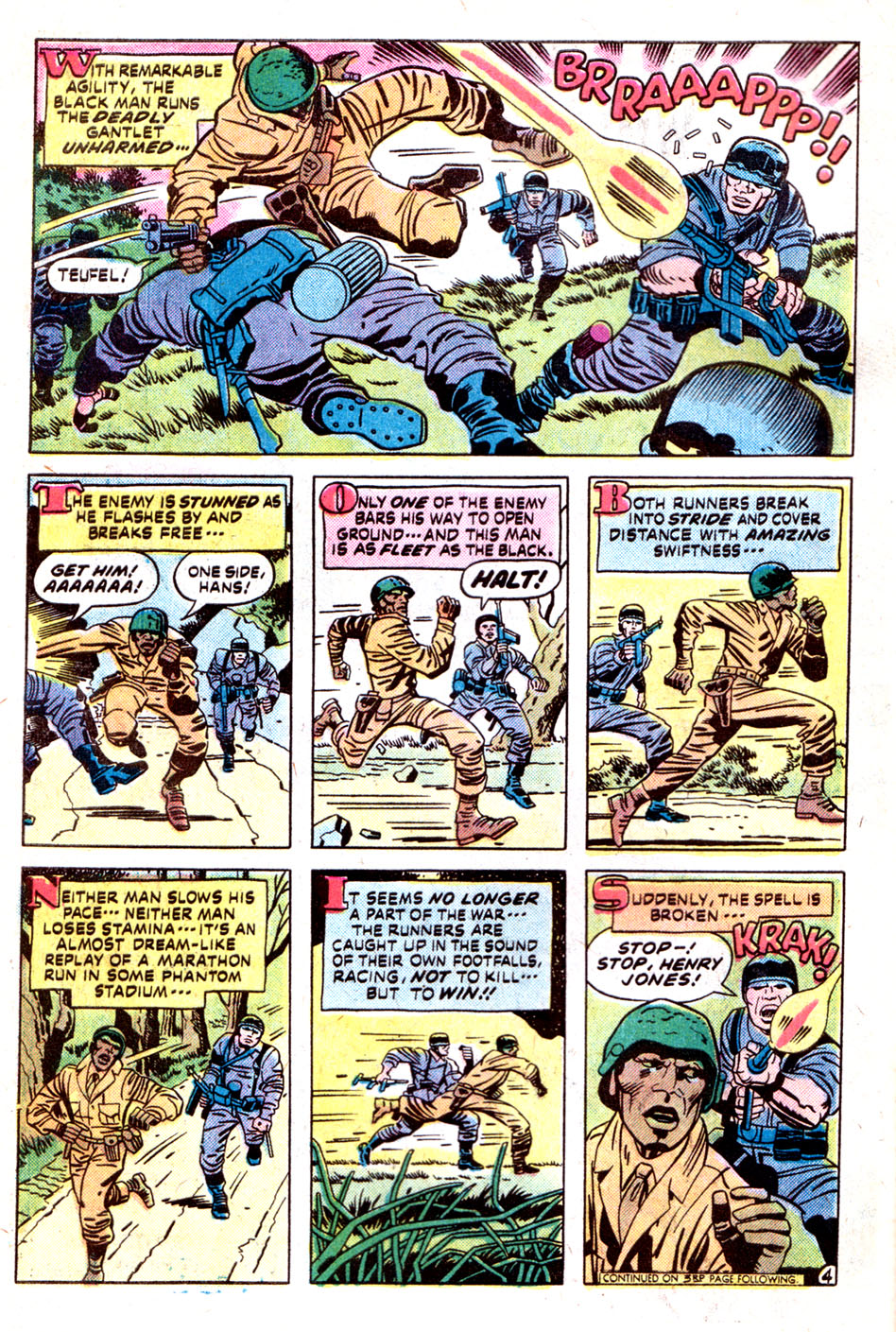
A Jack Kirby Losers story in
Our Fighting Forces 159 (Sept 1975) features a one-off appearance of Mile-a-Minute Jones, an African American soldier. Kirby appears to have played on Bob Kanigher's idea of making Jackie Johnson a world heavyweight boxing champ like the real life Joe Louis from the mid-20th century, by modeling his character on Jesse Owens, the Olympic champion athlete who won golds at the 1936 Games in front of Adolf Hitler, much to the Fuhrer's annoyance.
Jesse Owens starts the 200M at the Berlin Olympics in 1936
The story begins with a group of Nazis coming across an American truck that's been blown up. They check for survivors, anticipating there to be none, but the reckoned wrong. Henry Jones, star track athlete, makes his break for freedom, eluding all of his would-be executioners save one, who also shares his fleet-footedness. Turns out this mercurial Nazi is none other than Henry's old opponent in the Olympic Games, Bruno Borman. Also like Kanigher's Easy Co. story, in which Jackie Johnson slugs it out on the battlefield with his old opponent from the boxing world, here two more old sporting opponents meet in battle in WWII.
Bruno's link with Henry is that strong that he plans to make sure the other Nazis don't kill him. Whether he would have succeeded or not, we'll never know, because it's at this point that The Losers intervene, rescue Jones, and capture Borman, who happens to be holding the map his comrades need for their mission.
The Losers have a plan to capture the Nazi general, and they succeed. The other Nazi soldiers are left imprisoned, while The Losers seek to escape the area with their more valuable prize. Those Nazi troops escape, however, and the speedy Bruno catches up with The Losers and sprints across an open field to tip off the German paratroop patrol he spots in the distance.
As the only one fast enough to have a chance of catching Borman, Jones sets off in pursuit.
Jones relives the experience of being out on the track against Bruno. Just as in the 1936 Olympics, Jones again feels the urgency of undermining the Nazi claim of white racial superiority by running faster than Borman. He gains on Borman, but it reaches the point where he has to make his move if he's going to stop him in time. He leaps, but falls short. The paratroopers are alerted.
As the Nazi paratroopers turn in pursuit of The Losers, they get a deadly surprise - somehow Bruno and Henry had sprinted across a minefield unharmed, but the paratroopers are not so fortunate.
The engineer's tape that had marked the only safe route across the field had also acted as a kind of lane marker for Henry as he ran.
The Losers' ride out of this danger zone arrives. But despite escaping, Henry feels sadness due to the loss of his competitor, who lies dead on the battlefield. There will be no more contests on the track between Mile-a-Minute Jones and Bruno Borman.
The story, written by Jack Kirby, as students of Kirby's work will know, lacks that dimension Stan Lee gave to their collaborations. Nevertheless, this one is quite readable compared to some of his Fourth World material, which gets so convoluted that it often ceases to make sense. This tale is straightforward, and makes a simple point. Along the way we've seen the Nazi assumption of racial superiority again exposed. Although little was made of it at the beginning of the story, the American truck that had been blown up was manned by an African American segregated supply unit, by the looks of it, again bringing into the picture the paradox of segregated America fighting to defeat Nazi racists in an anti-racist war.


 During the 1940s, True Comics, of what might be called a true life, factual, or educational genre, promoted the humanist viewpoint of publisher George J. Hecht. A nice article about the series can be found on the Virginia Commonwealth University website. Quite a number of complete issues can be read in the Digital Comic Museum. Hecht used the comic to disseminate anti-racist propaganda that flew in the face of Nazi claims of racial superiority and inferiority, and of Aryan supremacy. True Comics 39 (Sept-Oct 1944) featured an overtly anti-racist piece entitled "There Are No Master Races", which presents practical reasons in support of racial equality. This story (and the whole issue) is available in the Digital Comics Museum, but the scans presented below are of higher resolution and are 'cleaned up'/edited with image editing software.