EnglishFrenchGermanSpainItalianDutchRussianPortugueseJapaneseKoreanArabicChinese Simplified
Showing posts with label Jack Kirby. Show all posts

May 28, 2011

X-Facts: 8 Interesting "X-Men (First Class)" Bits


Since their debut in September 1961, Stan Lee and Jack Kirby's "The X-Men" has become one of the most beloved comic book teams in history. With its premise of "mutants using their powers for the benefit of humanity" later mixed with engaging storylines that tackled issues of racism and prejudice among others, X-Men skyrocketed from the pages of a comic book towards worldwide popularity spawning toy lines, animated tv shows, video games, and a million-dollar movie franchise which included an X-Men film trilogy and a Wolverine Origins spin-off.

Now with the X-Men: First Class film just around the corner, here are some interesting facts about our all time-favorite mutant team that some of you may - or may not - know.

8) Contrary to "popular" belief, the "X" in the "X-Men" doesn't mean Xavier (after its mutant-telepath founder Charles Xavier). It actually referred to the "X-gene": an unknown gene that caused the mutant evolution which in turn gave other human beings "extra" powers or abilities.

    the X-Gene people. And its purple.


    7)Xavier's "School for Gifted Youngsters" complete address is 1407 Greymalkin Lane in Salem Center, in Weschester County in New York City. 

      Now you know where to find mutants.


      6) The original team was composed of Angel (Warren Worthington III), Cyclops (Scott Summers), Marvel Girl (Jean Grey), Beast (Hank-McCoy), and the snowball-throwing Iceman (Bobby Drake).  

        Snowballs. Beats Magneto every time.

        Snowballs, really?


        5) Not a lot of people know about this, but the idea of super powered/highly intelligent beings that were feared by humans first appeared in the science-fiction novel "Children of the Atom" by writer Wilmar H. Shiras - and is said to be the inspiration for the creation of the X-Men (though its never officially confirmed by its makers).

          The title "Children of the Atom" reappeared in 1999 as the title of an X-Men six-issue limited series that retold the team's origins, and of a 1994 classic arcade video game that had the most powerful Magneto EVER (at least in my opinion).


          4) Jean Grey (Marvel Girl/Phoenix) was the "apple of the eye" of everybody during the 1960's, with Cyclops and Angel competing for her affection. Apparently, they were not the only ones who had some kind of romantic love for Jean: the bald-headed Professor X did show some signs of having more than just "fatherly-love" towards her.

            I bet Charles and Jean had some kind of "telepathic-sex" back then and maybe... just maybe... that turned them into something like this:

            Bald Phoenix!!


            3)  Beast wasn't a "beast" back then... at least, not yet. He didn't sport the fur and the animalistic look which were all accustomed to see.
            He looked like a circus guy on a trampoline.


            But hey, at least this time in "First Class" film, Beast gets to kiss a teenage-hot Mystique. At least that's what I saw in the trailer. Not bad for a guy who eventually grew hairs in places you don't even want to know.


            2) Originally, Stan Lee wanted the series to be titled "The Merry Mutants". Because of its lameness, then-Marvel Publisher Martin Goodman turned it down and eventually changed it to "The X-Men".

              Really Stan? That's all you can come up with?

              Imagine if Goodwin gave the go signal for Lee's "The Merry Mutants". We would have titles like "The Uncanny Merry Mutants", the "Astonishing Merry Mutants", "The Merry Mutants: The Last Stand" or "The Merry Mutants: First Class" - all of them sounding like an 'effin comedy sitcom.

              We all have Goodwin to thank for folks.


              And finally...


              1) "The X-Men" was not all original like what most people think. They were based from another superhero team from the "House that Superman Built" who debuted 3 months before they did: 


              Wait is that Charles Xavier?

              DOOM PATROL, guys. Appeared in DC Comics in June 1963, the group consisted of once normal people who each got into an accident which in turn, gave them extraordinary powers.

              "That's sounds more like the Fantastic Four... how come the X-Men was a rip-off these guys?" Well let me count the ways:
              •  They were alienated from and feared by the human race because of their distinct "gifts".
              •  Just like the more marketable mutant team X-Men, Doom Patrol is led by a paraplegic in a wheelchair (The Chief). Only that DP's leader has hair and rocks a beard and mustache. 
              • Doom Patrol's main nemesis is group named... The Brotherhood of Evil. Now, if that doesn't sound familiar to you, X-Men's main villain - Magneto, leads a group which he calls The Brotherhood of Evil Mutants. 
              • Finally, the tag line for X-Men #1 is the freaking same as Doom Patrol's:
              from Cracked.com

              Interesting isn't it? Marvel didn't even bother to change their tag-line a bit and instead relied on the hope that readers would use their stupidity and therefore, not notice the obvious similarities.

              That's two points for Stan!


              If you like my post, subcribe to free updates via email or RSS.

              Feb 17, 2011

              Social History in Comics: Our Fighting Forces 159 - "Mile-a-Minute Jones!"


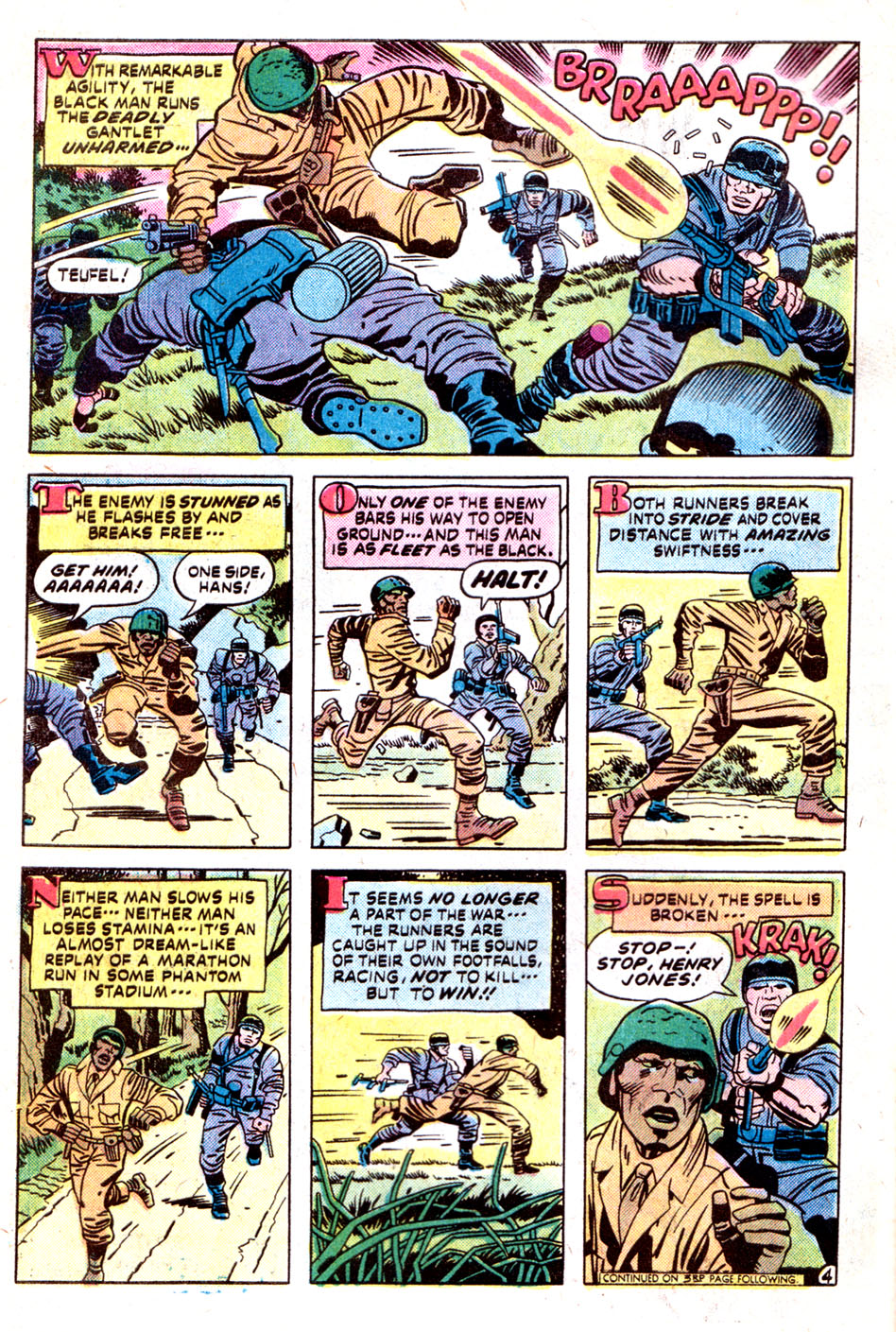
              A Jack Kirby Losers story in Our Fighting Forces 159 (Sept 1975) features a one-off appearance of Mile-a-Minute Jones, an African American soldier. Kirby appears to have played on Bob Kanigher's idea of making Jackie Johnson a world heavyweight boxing champ like the real life Joe Louis from the mid-20th century, by modeling his character on Jesse Owens, the Olympic champion athlete who won golds at the 1936 Games in front of Adolf Hitler, much to the Fuhrer's annoyance.

              Jesse Owens starts the 200M at the Berlin Olympics in 1936

              The story begins with a group of Nazis coming across an American truck that's been blown up. They check for survivors, anticipating there to be none, but the reckoned wrong. Henry Jones, star track athlete, makes his break for freedom, eluding all of his would-be executioners save one, who also shares his fleet-footedness. Turns out this mercurial Nazi is none other than Henry's old opponent in the Olympic Games, Bruno Borman. Also like Kanigher's Easy Co. story, in which Jackie Johnson slugs it out on the battlefield with his old opponent from the boxing world, here two more old sporting opponents meet in battle in WWII.


              Bruno's link with Henry is that strong that he plans to make sure the other Nazis don't kill him. Whether he would have succeeded or not, we'll never know, because it's at this point that The Losers intervene, rescue Jones, and capture Borman, who happens to be holding the map his comrades need for their mission.


              The Losers have a plan to capture the Nazi general, and they succeed. The other Nazi soldiers are left imprisoned, while The Losers seek to escape the area with their more valuable prize. Those Nazi troops escape, however, and the speedy Bruno catches up with The Losers and sprints across an open field to tip off the German paratroop patrol he spots in the distance.


              As the only one fast enough to have a chance of catching Borman, Jones sets off in pursuit.


              Jones relives the experience of being out on the track against Bruno. Just as in the 1936 Olympics, Jones again feels the urgency of undermining the Nazi claim of white racial superiority by running faster than Borman. He gains on Borman, but it reaches the point where he has to make his move if he's going to stop him in time. He leaps, but falls short. The paratroopers are alerted.


              As the Nazi paratroopers turn in pursuit of The Losers, they get a deadly surprise - somehow Bruno and Henry had sprinted across a minefield unharmed, but the paratroopers are not so fortunate.


              The engineer's tape that had marked the only safe route across the field had also acted as a kind of lane marker for Henry as he ran.


              The Losers' ride out of this danger zone arrives. But despite escaping, Henry feels sadness due to the loss of his competitor, who lies dead on the battlefield. There will be no more contests on the track between Mile-a-Minute Jones and Bruno Borman.


              The story, written by Jack Kirby, as students of Kirby's work will know, lacks that dimension Stan Lee gave to their collaborations. Nevertheless, this one is quite readable compared to some of his Fourth World material, which gets so convoluted that it often ceases to make sense. This tale is straightforward, and makes a simple point. Along the way we've seen the Nazi assumption of racial superiority again exposed. Although little was made of it at the beginning of the story, the American truck that had been blown up was manned by an African American segregated supply unit, by the looks of it, again bringing into the picture the paradox of segregated America fighting to defeat Nazi racists in an anti-racist war.

              Jan 29, 2011

              Social History in Comics: New Heroic Comics 81 - "Hill 528"


              The significance of New Heroic Comics 81 (March 1953), published by Famous Funnies, is that it contains a short true story about the bravery of Corporal Fred McGee in the Korean War. Corporal McGee is still alive today, and is a decorated veteran of the Korean War. In this two page story depicting the events on Hill 528 for which Corporal McGee received his honors, McGee is not shown as an African American, even though that is his identity. Personally I think it is unlikely that this omission was deliberate on the part of the comic book creators. It is more likely that it was simply assumed that McGee was white, because in the early 1950s institutional racism, if nothing else, tended to make society blind to the contributions of African Americans. It was as if a whole section of the population didn't exist, and you can see this by the absence of African American characters in comics throughout the 1950s especially. The error made on this comic is reminiscent of that made by the Marvel colorists on the cover of Sgt. Fury 1 in the early 60s - they simply assumed that all the characters were white, unaware of Lee and Kirby's intention to introduce diversity into the Marvel universe. Here then is "Hill 528". I wish that somebody who is a comic book creator would re-do this short story with McGee correctly depicted as an African American, and publish it somewhere while McGee is still alive.


              As a special treat, here's the inside back cover of the comic, which features a Boy Scouts of America National Jamboree ad drawn by none other than Frank Frazetta!


              Also, just to complete this short post, here's the cover of Sgt. Fury 1, showing the incorrectly colored Gabriel Jones:


              Gabriel Jones is the famous African American horn-blowing member of the Howling Commandos.

              Sep 14, 2010

              Nurses as Supporting Characters: Young Brides 17 - "Act of Faith"


              The interesting cover of this issue of Young Brides points to a different story that I'll hopefully get time to scan one day. Here we'll take a look at a medical romance story in the issue that features a doctor, with a nurse only playing a minor supporting role. Douglas Wilson is a newly qualified young doctor and husband, who fails to save his wife when she succumbs to peritonitis from a burst appendix. He blames himself for her death, quits the medical profession, and joins a traveling carnival as a mechanic (I'm sure I've read a few Simon/Kirby stories in which roustabouts and circuses feature!). After a while a young woman, Diane, falls for him, but Doug restrains himself from getting involved, even though he's attracted to her. His hand is forced when she becomes the victim of a violent ex-employee of the carnival, and Doug has to come out of the medicine cabinet and use his skills to save her life. That's the turning point, and he is able to move past his grief at the loss of his first wife, marry Diane, and resume his work as a doctor.


              The story is narrated by Doug, so it is in the minority as far as romance comics are concerned, in which the 'confessions' usually come from the woman. The image of nurses portrayed in this story is that of the Doctor's Handmaiden. She serves the doctor by following his orders and performing support duties such as taking calls. She's professional in her appearance and conduct, and in this story she's not in love with the doctor!

              Jun 9, 2010

              Nurses At War: Young Romance 78 - "Army Nurse"

              It took me some time to get this book. These Simon and Kirby post code issues are fairly tough to find. The cover is directly related to the nurse romance story that I am interested in here, set in a Mobile Army Surgical Hospital in Korea. The art is by Argentinian artist Jo Albistur (signed).

              In "Army Nurse", the nurses all love Doctor Roy, but the Doc only has eyes for one of them, and that's Joyce. He's been preparing to pop the question, and does so after a hard day's work. Joyce is over the moon to be engaged to her dream boat.
              For some reason Roy keeps quiet about why he seems to always be giving Ruth Duryea assignments to work with him. Sure, he gives some plausible explanations - she's new and needs the training - but it doesn't quite all add up. Suddenly Joyce is snapped out of her jealous fog by the news that Roy's aircraft has gone down, and he's hurt. Joyce immediately volunteers to be the nurse to travel to the crash site. On the way the flak from the North Koreans almost makes her wish she'd stayed back at the camp, but she gets there to find Ruth tending to her intended. This is a bit much for her to take, and she removes her engagement ring from her finger and slips it into Roy's pocket, her dream perhaps over. Setting aside her jealousy, Joyce does the needful. Back at the M.A.S.H. Roy is operated on. However, afterward Ruth flies in and is assigned to the care of the wounded. It is then that Joyce discovers something that changes the whole picture.
              Ruth has no romantic inclinations towards Roy. She's already married to the injured sergeant, secretly, because it's against regulations. Doctor Roy Nelson knew and has been covering for them. Joyce realizes what a chump she's been and fumbles in Roy's pocket to get her ring back. He's already ahead of her though, having found the ring there himself. He sees that his position, surrounded by a flock of marriageable, lovely nurses makes life difficult for Joyce, and so he prescribes the only reasonable cure - a wedding.
              I like this artwork by Jo Albistur. I think I have another example of his work somewhere. He's mentioned on the Simon & Kirby Museum blog. It reminds me somewhat of Al Williamson's work. The image of nurses presented by this piece include the usual - aspiring for romantic involvement with a doctor, bitchy rivalry, they're all pretty in their nicely starched white uniforms and caps. These are nurses at war so there's bravery and willingness for self-sacrifice. Nice switch to the blue uniform for going out into the battlefield. Ruth Duryea is a redhead for the cover but blond in the story. Panel 7 on page 5 looks like it was intentionally drawn to match the cover, and is a little out of Albistur's natural style as a result (the cover looks Kirby or Simon/Kirby to me).
              Related Posts Plugin for WordPress, Blogger...