|
|
|
|
|
Showing posts with label Charlton Comics. Show all posts
Sep 8, 2010
Nurse Romance Stories: Teen Secret Diary 11 - "Nurse Betsy Crane"
Charlton's Teen Secret Diary 11 is a key issue in the flowering of the medical romance genre. It is the first such comic in that early 60s 'explosion' triggered by the success of television series like Dr. Kildare and Ben Casey (Dell comic book versions of which followed later, after this sub-genre was established by Charlton). Although she's a stereotypical red-head in this story, Betsy must have dyed her hair, because in subsequent issues she's shown with black hair. Approximately 20% of nurses depicted in romance and war comics from the late 40s through the early 60s are redheads, far exceeding the incidence of red hair in the population, suggesting a stereotype possibly originating with a period earlier in the 20th Century during which Irish nurses were well-represented amongst nursing recruits. Charlton perhaps reconsidered the color of Betsy's hair as they prepared to launch their next nurse romance title, Cynthia Doyle Nurse in Love, with Cynthia remaining a redhead throughout the series.
Nurses in these early 60s romance comics are beginning to display characteristics of the liberated woman of later in the decade. Betsy is independent, capable, and intelligent. She is able to read situations better than the doctor she is the 'handmaiden' to. But the narrative on the splash page really captures the stereotype of Betsy's generation of nurses in a nutshell. Nursing is an occupation for women, and their female characteristics merge with their professional identity such that the two are inseparable.
Betsy, and a twist of fate, brought the doctor back from the depths of despair to resume his valuable career. Elsewhere in this comic there's a nursing recruitment ad, which presents an image of nurses congruent with that promoted by this and other nurse comic book stories of the time.
Charlton changed the title of the series to Nurse Betsy Crane with issue 12. It was the first and longest running medical romance series in comics, ending with issue 27. Charlton also reprinted the Betsy Crane stories in the five issue series Soap Opera Romances, one of the last titles in the romance genre, from July 1982 through March 1983.
Posted by
rm4d4n1
Labels:
Charlton Comics,
Nurse Betsy Crane,
nurses,
nursing ad,
Romance Comic Covers,
Teen Secret Diary
Jun 8, 2010
Cute Girlie Stuff: Paper Dolls and Katy Keene
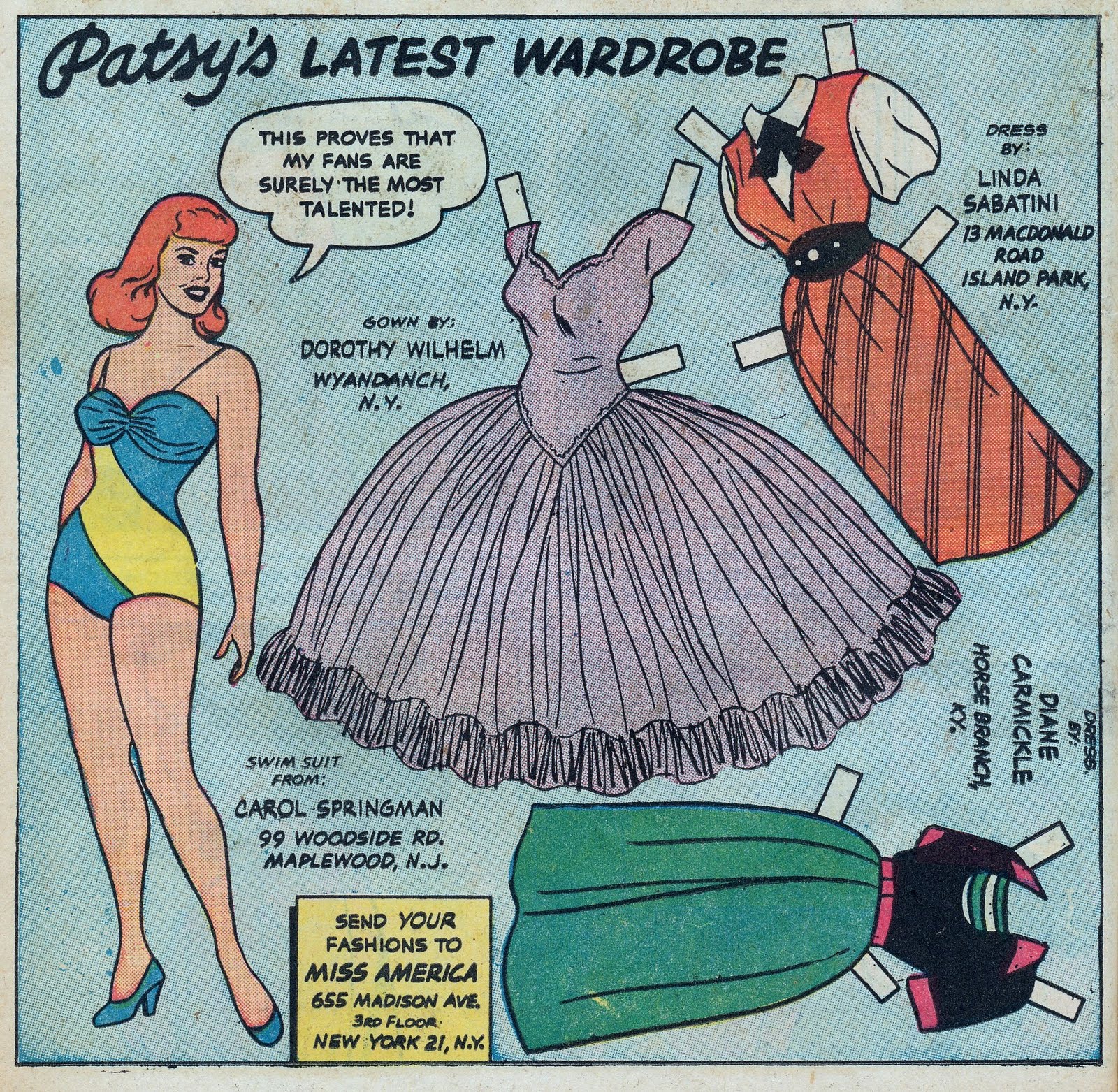
Earlier this year I found Linda's 'The Paper Collector' blog when I was searching for information on Torchy Brown, a newspaper comic strip drawn by the first African American female comic artist, Jackie Ormes. Linda had a feature about Torchy Brown on one of her other blogs, in which she had posted scans of a Torchy Brown strip and the accompanying Torchy Brown paper dolls. Kind of out of the corner of my eye I noticed that paper dolls have a very enthusiastic following, just like comic books. And here was an instance where the two disciplines meet - comix scholars and paper doll students. I would be interested to know just when this association between the two began. The Torchy Brown strip featured in Linda's post is from the early 50s. I looked through some of my comics that I suspected might have paper dolls and sure enough I came up with some (well I knew I'd seen them in there before). Here's some examples:
This is Patsy Walker 49 published by Atlas in November 1953. It has just one page with a paper doll. It says it's #16 (in a series?), and the clothing design appears to have been sent in by a reader.
Here's Patsy Walker in Miss America 86 from September 1957, again published by Atlas. The cover is one of the many from this period that depict 1950s suburban and small town life by the superb Al Hartley. Only one page with a paper doll on again.
Archie's Pals 'n' Gals 21 from Summer 1962 has a couple of pages with Veronica paper dolls. Are these drawn by Jon D'Agostino?
Patsy Walker 104 (Marvel, December 1962) has another great Al Hartley cover plus no less than three pages of paper dolls. Al seems to have left off the tabs from the outfits, either by design or forgetfulness - which, we'll never know. If I ever get to interview Stan Lee I have more pressing issues to ask him about, but more out of idle curiosity I might just ask him (in my dreams!). So paper doll collectors, where there's Patsy there's dolls, at least from the mid-50s through the mid-60s, as we shall see.
This one definitely is drawn by Jon D'Agostino. It's Charlton's My Little Margie 49 from September 1963, and it has just one page with a Margie cut-out doll. Note the continuing theme of reader-generated designs.
Patsy Walker 119 (Feb 1965) and Patsy & Hedy 99 (Apr 1965) each have two pages of paper dolls, but it seems that Al Hartley's tab-less outfits have persisted even though he's no longer the artist. But where does Katy Keene come into all this? Well I'm pretty sure paper dolls can be found in Katy Keene comics but I don't have proof. This is because every time I try to obtain a Katy Keene comic on eBay I get outbid or the Buy It Now price is more than I'm willing to pay. Katy Keene has a following. Katy Keene is popular. Katy Keene was published by Archie and drawn in irresistible fashion by Bill Woggon. It turns out though that, quite by accident, I do have one example in my collection. My copy of Laugh 114 (September 1960) has a 6 page Katy Keene story. So here it is - not too many panels with Katy in but enough to get a taste of Bill Woggon's unique artwork. Katy is a doe-eyed, dark-haired, perfect beauty drawn in a way that is confusingly pleasing to the eye, hence Woggon's popularity and the cost of Katy Keene books. This is, I would say, a kind of good girl art, a topic I would like to explore on another occasion, as a I feel a clear definition of the term is long overdue.
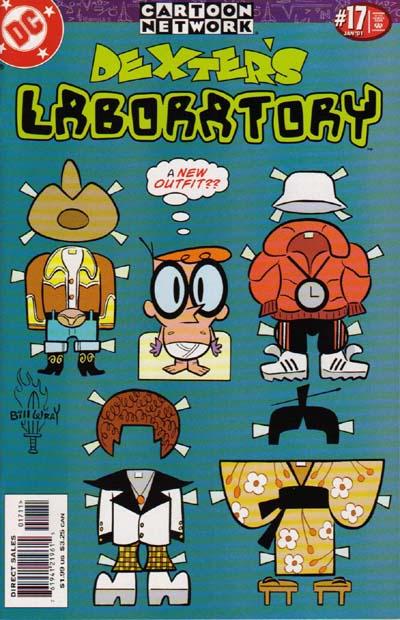
Even though there are no paper dolls with this one, the story itself uses outfits designed and sent in by readers, as do the other books sampled in this post. Thus ends my first real excursion into the world of paper dolls through the portal of comics, with a diversion into Katy Keene, as a special thanks to Linda for giving me permission previously to use her Torchy Brown scan for my presentation and article. It's also mine and my wife Sheila's 27th wedding anniversary today, and she's often told me how she used to play endlessly with paper dolls when she was a girl in the 50s. So it's nice for me to contact something from my spouse's childhood experience. Just to finish, the most recent comic that I'm aware of with, in this case, spoof paper dolls is Dexter's Laboratory 17 published by DC in January 2001. I just sold my son's collection of these and forgot to scan the cover of this one before it went, but there's a complete cover gallery in the GCD, in which you can view the one I'm referring to.
Posted by
rm4d4n1
Labels:
Al Hartley,
Archie,
Atlas,
Bill Woggon,
Charlton Comics,
DC,
Dexter's Laboratory,
Jon D'Agostino,
Katy Keene,
Marvel,
Miss America,
My Little Margie,
paper dolls,
Patsy and Hedy,
Patsy Walker
Mar 23, 2010
Ultimate Romance: Cynthia Doyle Nurse In Love #68
One of the most interesting things, to me, about hospital romance comics, is that in the 'dance' of the nurse and the doctor, we see enshrined the male-female hierarchy that has underpinned our society for centuries. Medicine is male, scientific, rational, and has assumed authority over female nursing, with the latter's attention to the personal, its emphasis in caring exploited as a weakness in this battle of the sexes. Consequently, the nursing profession's focus, in its quest to achieve enhanced status, has in many ways been one that has attempted to accentuate the 'masculine' - the scientific basis for nursing - and de-emphasize the femininity that belongs to the traditional image of nurses. That femininity equates, in a patriarchal society, with submission and subordination to the male. So long gone are the distinctive nurse uniforms that adorn the characters in romance comics, and instead in real life we have unisex, mostly loose fitting scrubs that lessen the distinction between the various medical professionals and between male and female. This is very much the end product of second wave feminism, but as with many reflections on what has become as a result of that chapter of social evolution, sometimes we're left wondering if something valuable might have been lost along the way.
Cynthia Doyle Nurse in Love is one of that group of Charlton hospital or medical romance books published from the early- through mid-1960s that rode the wave of enthusiasm for television dramas of the same genre and same time period - Ben Casey, Dr. Kildare, The Nurses (all adapted for comic books by Dell), and no doubt others that I'm unaware of. As you've seen from some of my other posts, nurses were a common feature in romance comics throughout their history, but for a few brief years hospital romances emerged as a sub-genre all of their own. The nurse-doctor relationship that was the basis for these romances was as dependent upon the traditional male-females roles as the whole romance genre itself, and in many ways was a distilled version of it. So it seems as feminism began to influence society and change the way that relationship was seen, the hospital romance went by the wayside along with romance comics generally as both failed to adapt.
What makes these hospital or medical romance books unusual is that they are series featuring the same characters, unlike most romance books in which the stories are usually one offs. Charlton, Dell, DC, and Marvel all had medical romance series of various descriptions, although Charlton and Dell were certainly the leaders in this field. Outside of medical series, I can think of the random appearances of Jonnie Love in Charlton books, and various DC running features, like Bonnie Tyler the airline hostess in Young Romance, The Life and Loves of Lisa St. Claire in Young Love, and so on. As is the case in other circumstances, Charlton seems to have been the innovator, at least a pioneer, both of the ongoing series in a romance book as well as the medical romance sub-genre. Nurse Betsy Crane begins August 1961, with Marvel's Linda Carter Student Nurse in September '61 and Dell's Linda Lark, Student Nurse in October of the same year. DC's Mary Robin R.N. didn't begin until the September 1963 issue of Young Love.
So this is something of a stereotyped male-female interaction but one which has perhaps a strong basis in reality. The woman has to play the game of allowing the male ego to maintain its illusion of superiority. At the same time, because something important is at stake, she has to figure out a way to get the necessary done while going around the obstacle erected by the male's obstinacy.
Calculated submission was the way first wave feminism attained limited autonomy for middle class women, within a restricted professional realm led by nursing and social work. The early 1960s is near to the end of that phase, the closing of a chapter that began with Florence Nightingale and ended with Night Nurse! This story was "The Case of the Teenage Mother" from the Feb 1963 issue of Charlton's Cynthia Doyle Nurse in Love (issue #68).
Cynthia Doyle Nurse in Love is one of that group of Charlton hospital or medical romance books published from the early- through mid-1960s that rode the wave of enthusiasm for television dramas of the same genre and same time period - Ben Casey, Dr. Kildare, The Nurses (all adapted for comic books by Dell), and no doubt others that I'm unaware of. As you've seen from some of my other posts, nurses were a common feature in romance comics throughout their history, but for a few brief years hospital romances emerged as a sub-genre all of their own. The nurse-doctor relationship that was the basis for these romances was as dependent upon the traditional male-females roles as the whole romance genre itself, and in many ways was a distilled version of it. So it seems as feminism began to influence society and change the way that relationship was seen, the hospital romance went by the wayside along with romance comics generally as both failed to adapt.
What makes these hospital or medical romance books unusual is that they are series featuring the same characters, unlike most romance books in which the stories are usually one offs. Charlton, Dell, DC, and Marvel all had medical romance series of various descriptions, although Charlton and Dell were certainly the leaders in this field. Outside of medical series, I can think of the random appearances of Jonnie Love in Charlton books, and various DC running features, like Bonnie Tyler the airline hostess in Young Romance, The Life and Loves of Lisa St. Claire in Young Love, and so on. As is the case in other circumstances, Charlton seems to have been the innovator, at least a pioneer, both of the ongoing series in a romance book as well as the medical romance sub-genre. Nurse Betsy Crane begins August 1961, with Marvel's Linda Carter Student Nurse in September '61 and Dell's Linda Lark, Student Nurse in October of the same year. DC's Mary Robin R.N. didn't begin until the September 1963 issue of Young Love.
So this is something of a stereotyped male-female interaction but one which has perhaps a strong basis in reality. The woman has to play the game of allowing the male ego to maintain its illusion of superiority. At the same time, because something important is at stake, she has to figure out a way to get the necessary done while going around the obstacle erected by the male's obstinacy.
Calculated submission was the way first wave feminism attained limited autonomy for middle class women, within a restricted professional realm led by nursing and social work. The early 1960s is near to the end of that phase, the closing of a chapter that began with Florence Nightingale and ended with Night Nurse! This story was "The Case of the Teenage Mother" from the Feb 1963 issue of Charlton's Cynthia Doyle Nurse in Love (issue #68).
Posted by
rm4d4n1
Mar 5, 2010
Who Is The Artist?
I was sorting through my comics and flicked through this one when I came across it: First Kiss 4 (Charlton, July 1958). The content of the cover, by Jon D'Agostino, has no connection with any of the stories in the book. Nothing particularly unusual there! The first couple of stories did make me stop and look at them more closely. They reminded me of work that I've assumed was by Vince Colletta, although the inking seemed light, even for him. So I've scanned them both (only 5 pages each) so that you all can take a look at them and tell me what you think. Are they Colletta pencils, inks, both, neither?
The first story, "Party Girl" - is standard romance comic fare - the girl who loves to party isn't considered a contender for a serious relationship, certainly not marriage. [I'm sure I've seen that last panel on page 4 on a Colletta Atlas romance cover! Something very like it anyway.] When the hard truth hits home, it's time for Barney to come forward and reveal the feelings he's had for Dory all along!
"Made for Romance" is a career girl romance. Pam Foster works in advertising, and is good at her job. Allan Kane, an artist for the company, thinks glamor is the future of advertising, and wonders how plain Pam made it so big in the business. Enter the boss's son, Harry, and of course Pam falls for him although he apparently doesn't notice her, because she's not glamorous! Allan organizes a complete makeover for Pam. It takes a week, but it appears it was worth it. Personally I thought Pam was pretty fine in the first place, but there you go. But all the effort was for nothing - Harry announces he's getting married. The strange thing is, now Pam doesn't care. That week doing the makeover with Allan has done something special for both of them. So all's well that ends well.


For comparison, I'm adding a panel from Gorgo 8 (Charlton, August 1962) that was definitely drawn by Joe Sinnott and inked by Vince Colletta or someone in the Colletta Shop (this information was provided to me by Ramon Schenck, who had access to Joe Sinnott's notebook via his contacts with Joe's family). I see similarity between this Gorgo panel and the second panel on page 3 of the "Made for Romance" story above. Note the angle of the man's head in his approach to the woman to kiss her, his jaw line, the way the ears are drawn, and his lowered eyelids. I've added this to support Apocolyte's suggestion in the comments below, that these stories could be examples of Joe Sinnott pencils with very rushed Colletta or Colletta Shop inking. John Lustig ("Last Kiss") also provided detailed information in the comments below, establishing that the work was fully Colletta Shop, adding that Joe Sinnott did work for the Studio. Here's that panel from the story above as well, for ease of comparison. If this identification is correct, the Gorgo panel gives a hint of what these two First Kiss stories could have looked like.
I love Hal's optimism there in the Gorgo 8 panel.
Posted by
rm4d4n1
Labels:
Charlton Comics,
First Kiss,
Gorgo,
Joe Sinnott,
John Lustig,
Jon D'Agostino,
Romance Comic Covers,
Vince Colletta
Subscribe to:
Posts (Atom)